

Across the Central Baltic region, the wood construction sector faces a paradox. While companies struggle to find skilled workers, many young people find it difficult to enter the labour market. The challenge is not a lack of interest: many young people are curious about construction-related careers, but often lack practical skills, work experience and a clear understanding of job opportunities in modern industrial wood construction.
The international project Wood for Youth was created to address this gap. Through cooperation between partners in Estonia, Latvia and Finland, the project developed a new training approach designed to strengthen young people’s competitiveness on the labour market while helping companies connect with future employees.
Rather than focusing on theory alone, the initiative brought together digital learning, practical experience and direct interaction with industry.
Learning that connects education with real work
A central idea behind Wood for Youth was that young people learn most effectively when engaging, visually rich e-learning — offering flexible and focused learning opportunities — is combined with real-life exposure to the sector. The project therefore developed a practice-oriented training model that integrates interactive digital learning with hands-on experiences and direct engagement with companies.
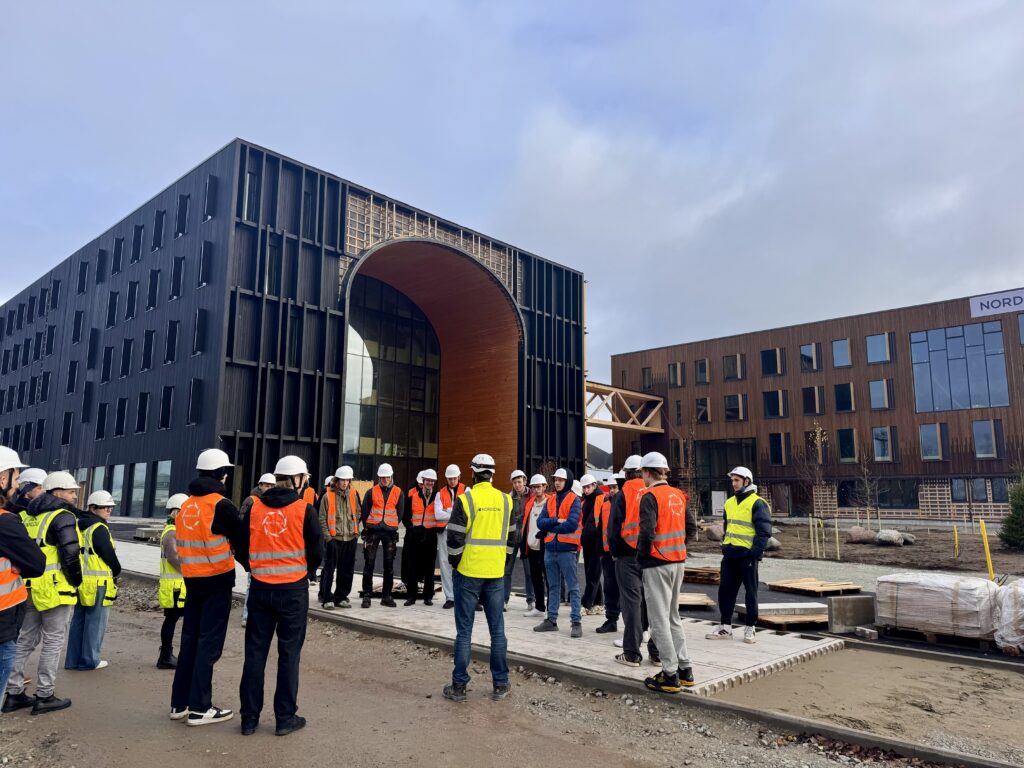
Hundreds of participants explored the fundamentals of industrial wood construction through an online learning environment and complemented their learning through factory visits, construction site observations, study trips and internships in woodhouse manufacturing companies. These experiences allowed students to see how modern timber buildings are produced and assembled in real industrial settings.
“Young people are interested in building careers in construction, but they rarely see how modern industrial wood construction actually works. By opening factory doors, construction sites and learning platforms, the project helped young people connect education with real career opportunities,” says Annika Kadaja, General Manager of Estonian Woodhouse Association and initiator of the Wood for Youth project.
Over the course of the project:
- 288 young people successfully completed the training programme
- more than 400 young people participated in project learning or engagement activities
- several participants progressed to internships, employment or further studies in the sector.
A stronger link between education and industry
One of the most important outcomes of the project was the development of a joint cross-border training curriculum and methodology for industrial wood construction. The model was designed to be flexible and adaptable, allowing it to be applied in different educational contexts and countries.
Industry participation played a key role in the development and implementation of the programme. A total of 15 woodhouse manufacturing companies across Estonia, Latvia and Finland contributed to the project by providing input on required skills, supporting training activities and offering opportunities for internships and workplace learning.
“For companies, the challenge is not only finding workers but finding people who understand the industry. Programmes like Wood for Youth help shorten the distance between education and real work, giving young people a clearer picture of the sector and helping companies discover motivated future employees,” says Elar Vilt, Project Development Manager of Wood for Youth.
The project also attracted significant interest from educational institutions. Several upper secondary schools expressed interest in using the course as an elective subject, while vocational and higher education institutions explored ways to integrate the training materials into existing curricula.
In Estonia, the professional relevance of the developed training was further recognised when the Estonian Association of Civil Engineers evaluated the course as equivalent to 20.9 continuing professional development points, highlighting its value not only for young entrants but also for experienced professionals seeking additional training.
A training model that continues beyond the project
Importantly, Wood for Youth did not end with the project’s final activities. The training model, learning materials and cooperation networks created during the project will continue to be used and developed further.
In Estonia, the courses will remain available through the Woodhouse Academy platform. In Latvia, the initiative will continue through the New Construction School, while in Finland the materials will be integrated into new digital learning platforms and disseminated through the Wood Construction Academy initiative.
The project partners are already exploring possibilities to expand the training content with new topics, such as building operation and maintenance or the long-term performance of construction materials.
“What we saw during the project was that once young people experience the industry first-hand, their perception changes quickly. Factory visits, internships and real-life examples make the sector tangible and help young people see that there are exciting career paths in modern wood construction,” comments Piret Jaani, the Project Manager of Wood for Youth.
The experience of Wood for Youth demonstrates that practice-oriented learning models combining digital tools with industry engagement can significantly improve young people’s readiness for the labour market. By making career pathways more visible and accessible, such initiatives can help strengthen the competitiveness of young people while supporting the long-term development of the wood construction sector. At the same time, the project highlights the value of cross-border cooperation in the Central Baltic region, where countries face similar skills challenges and can benefit from developing and testing solutions together.
The programme activities were funded through the Wood for Youth project under the Interreg Central Baltic Programme, Objective No. 6: “Improving labour market employment opportunities.”
More information about the Woodhouse academy: https://academy.woodhouse.ee