
On 28 January, the final seminar of the international Wood for Youth project took place at TTK University of Applied Sciences, where the three-year work of the Woodhouse academy was reviewed and representatives of the education and wood construction sectors discussed how to further develop education solutions targeted at the woodhouse industry.
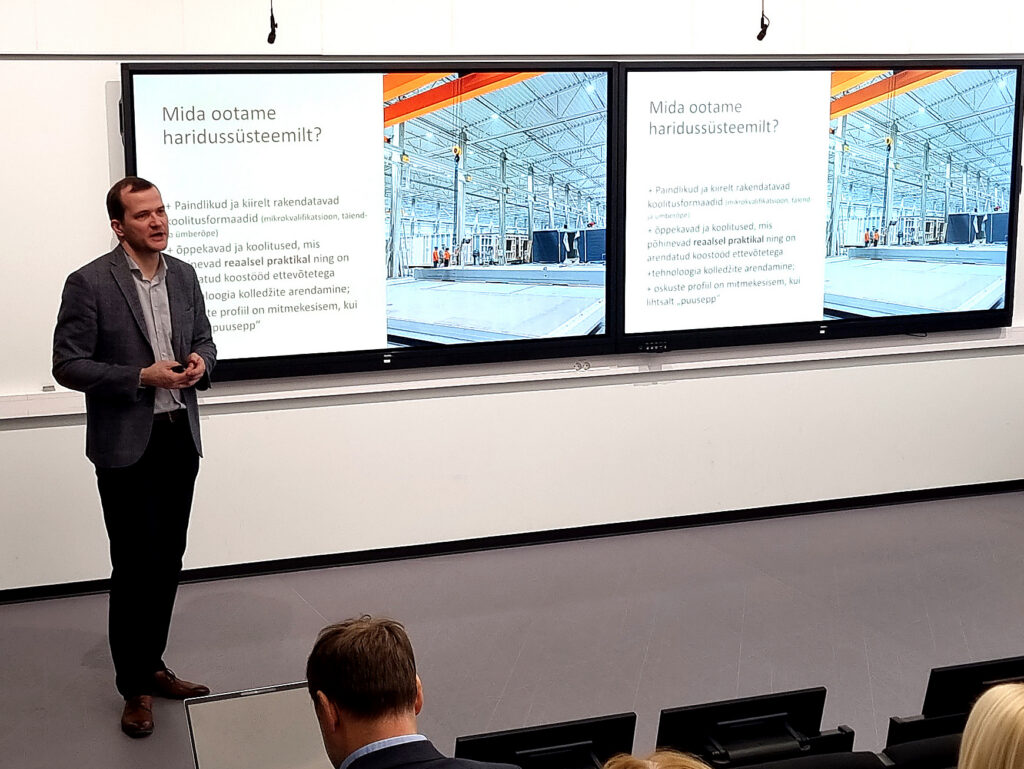
The Woodhouse Academy is a free, interactive e-learning programme initiated by the Estonian Woodhouse Association in cooperation with woodhouse manufacturers and educational institutions. Its aim is to bring young people closer to the woodhouse industry and to provide them, within a short time, with practical and labour-market-oriented knowledge, thereby increasing young people’s competitiveness in the timber construction sector.
The programme consists of educational videos that mainly include filmed work processes, animations, and 3D illustrations and models. E-learning can be completed at any time and at the learner’s own pace. In addition to online learning, the programme also offers various practical activities, including internships at house factories, observation placements on construction sites, and study visits abroad. Among others, the e-learning courses “Factory-based Production” and “Building Assembly” have been awarded a total of 20.9 continuing education points (CPD) by the Estonian Association of Civil Engineers.
In less than a year, more than 800 learners registered for Woodhouse Academy courses, of whom 264 passed the exam and received a certificate. Particularly noteworthy is the participation of the programme’s main target group – young people under the age of 25. In this age group, 132 young people obtained a certificate, demonstrating that the interactive e-learning format strongly resonates with young learners. Within the project, young people also gained practical experience at woodhouse manufacturing companies in cooperation with enterprises, vocational schools, and upper secondary schools, and many have already found employment in the sector.
“The Woodhouse Academy courses helped me better understand how woodhouse production actually works. I am about to graduate from Tallinn Construction School, and when I started my internship and later my job at Nord Homes, I clearly felt the value of the knowledge gained from the courses. It provides a solid understanding of factory-based construction processes and work organisation,”
said programme participant Marek Matt, who now works at the Nord Homes house factory.
The seminar also addressed the situation of the construction sector in Europe and Estonia, as well as the expectations companies have of the education system. Margus Haidak, Head of the Department of Higher Education Policy and Lifelong Learning at the Ministry of Education and Research, outlined expectations related to education reforms and initiated a discussion among participants about the challenges of fulfilling compulsory education requirements. The business perspective was presented by Alo Tamm, CEO of Harmet OÜ and Vice Chairman of the Board of the Estonian Woodhouse Association, who emphasised the need for young people with versatile and practical skills, as well as the importance of more flexible and quickly applicable learning opportunities.
The development and future prospects of the Woodhouse Academy were presented by Piret Jaani, Education Coordinator at the Estonian Woodhouse Association. According to her, one of the academy’s key strengths is that its courses can be integrated into vocational schools, upper secondary schools, and higher education curricula, and used in cooperation with companies, bringing a direct connection between education and the real needs of the industry.
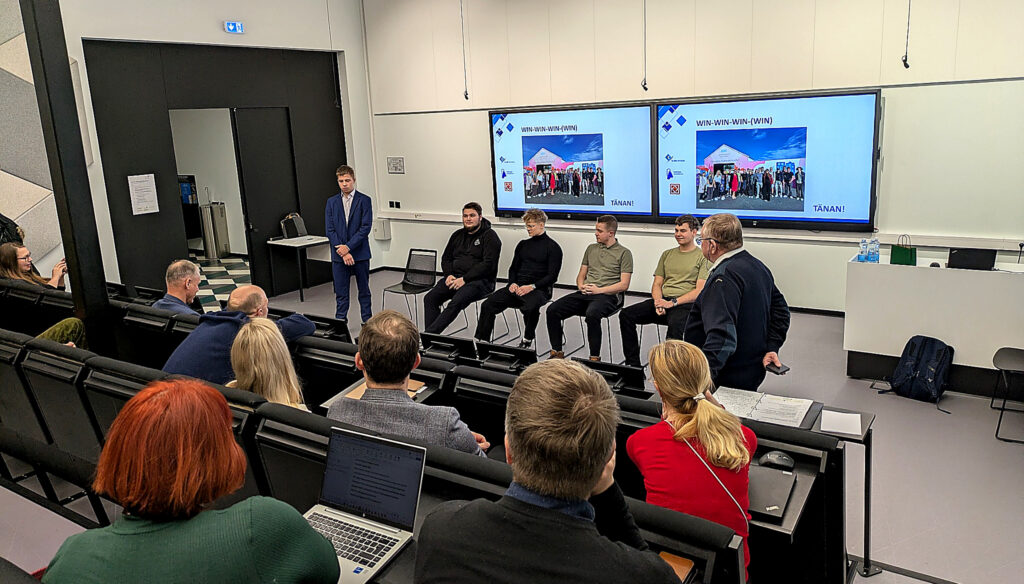
In the second half of the seminar, representatives of TTK University of Applied Sciences, Tallinn Construction School, and Rapla Upper Secondary School shared their experiences of integrating Woodhouse Academy courses into teaching. Feedback highlighted a high level of trust in the courses, as their content is based on real-life practices and the courses are logically structured. Discussions showed that schools have applied e-learning in different ways, but jointly recognised significant potential for further development and the creation of new learning materials.
“The Woodhouse Academy makes it possible to bring a modern industrial perspective into education and helps connect theory with real-life practice. It is a valuable addition to our existing learning opportunities, and every forward-looking school can find ways to integrate these courses into their curricula,”
said Tõnu Armulik, Development Director of Tallinn Construction School.
The day concluded with a panel discussion titled “How and how far do we go next?”, focusing on the continuation of the Woodhouse Academy, the development of new courses, and strengthening cooperation between companies and educational institutions. The final seminar of the Wood for Youth project confirmed that the Woodhouse Academy has become an important bridge between education and the woodhouse sector, creating a strong foundation for young people’s more informed and smoother transition into the construction labour market.
The programme activities were funded through the Wood for Youth project under the Interreg Central Baltic Programme, Objective No. 6: “Improving labour market employment opportunities.”
More information about the Woodhouse Academy:
👉 https://academy.woodhouse.ee/